
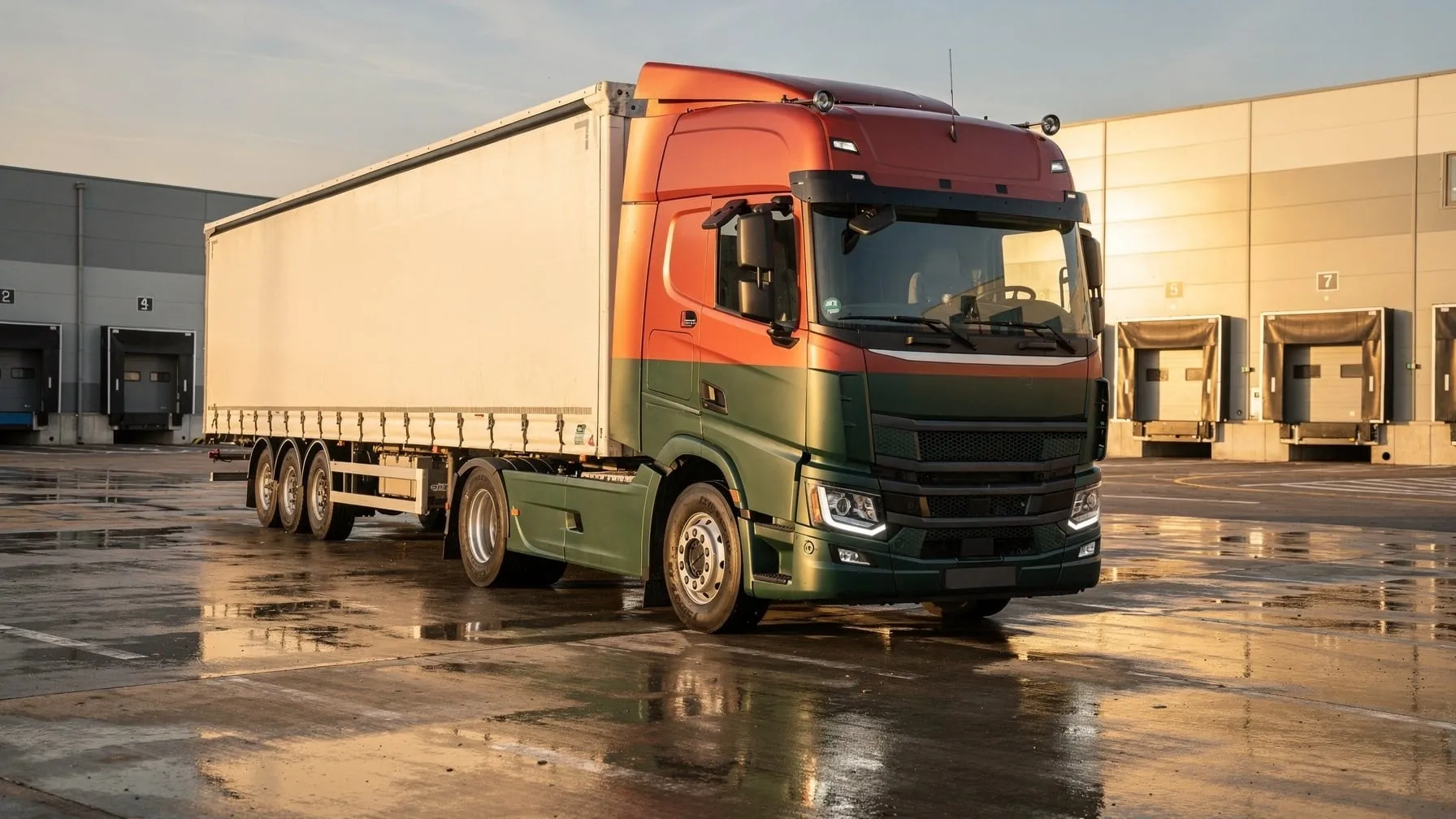


Half past three, and the country is waiting for its freight
A driver, a haulier, a driving instructor — three views of the trade that keeps this country running. And of a calculation that no longer works out for any of them.
At 3.40 a.m. on a Tuesday in September, the yard of a small haulage firm in Upper Bavaria is the brightest place for two kilometres. Five articulated lorries stand in a row, auxiliary heaters running, radio music drifting out of one cab. What happens here in the next twenty minutes decides whether, the day after tomorrow, there is milk on a supermarket shelf in northern Germany. It is the least conspicuous process in the German economy — and one of the most expensive.
The first hour belongs to the vehicle
Ralf W. is 54, has spent thirty years in long-haul, and starts his working day on his knees. Torch between his teeth, the back of his hand on the brake hoses, eyes on the tread depth. He taps the tyres, checks the fifth wheel, pulls on the lashing straps, glances at the AdBlue level. The pre-departure check is a legal duty, and on a good morning it takes twelve minutes.

From getting up to the first paid kilometre, about an hour passes. What gets paid is the kilometre, not the diligence. "If you do the check sloppily, nobody notices," he says. "Until somebody does."
What a litre costs
The first stop is the company fuel pump. What runs into the tank there is the reason why the same calculation is sitting on every haulage desk in Germany this autumn. The Federal Statistical Office puts the diesel price for bulk buyers in July 2026 at 171.61 euros per 100 litres net of VAT. In July 2025 it was 125.70 euros. That is 36.5 per cent in twelve months. Between June and July of this year alone, the figure jumped by 24 per cent.

The arithmetic behind it is bleakly simple. An articulated lorry uses around 30 litres per 100 kilometres and covers 120,000 kilometres a year: 36,000 litres. The 46-cent-per-litre increase on last year comes to roughly 16,500 euros of extra cost — per vehicle, per year. For five vehicles that is 82,500 euros nobody ordered and nobody budgeted for. At the public pump these days, the display reads around 2.30 euros a litre.
The yard where the sums are done
Andreas H. is 57 and owns those five vehicles. His father started with one. At half past five he is standing in the yard, quilted jacket, tablet in hand, doing what by now takes up most of his time: sums. On top of diesel comes the toll. A 40-tonne Euro VI lorry in the cheapest CO2 class currently pays around 34.8 cents per kilometre. Before the CO2 surcharge was introduced in December 2023, it was about 15 cents. The surcharge alone accounts for 15.8 cents — the toll has almost doubled.
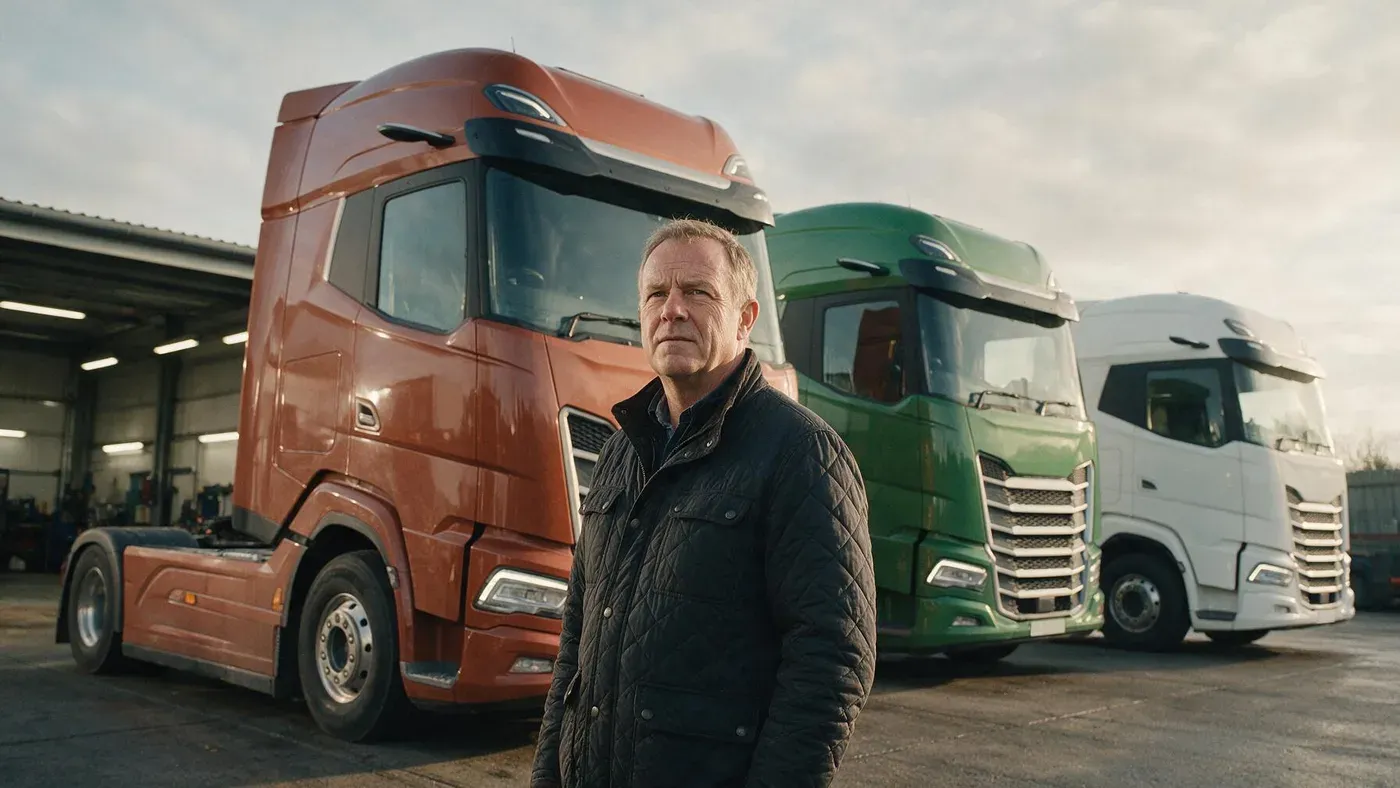
Then the vehicles themselves. A new tractor unit today costs well over 130,000 euros, a trailer 40,000. A set of drive tyres runs into four figures, so does a turbocharger, and an unplanned week in the workshop costs not just the repair but the run. Insurance, vehicle tax, telematics, dispatch and payroll carry on whether the lorry is rolling or up on the lift.

What a long-haul kilometre really costs
- Driver cost incl. employer contributions and per diems
- €0.44
- Fuel (30 l/100 km at €1.72 net)
- €0.52
- Toll (34.8 ct on roughly 80 % of the distance)
- €0.28
- Depreciation / leasing, tractor and trailer
- €0.20
- Maintenance, tyres, repairs
- €0.13
- Insurance, tax, dispatch, administration
- €0.15
Indicative figures for a domestic long-haul articulated lorry at 120,000 km a year, as of September 2026. Empty running, waiting time and capital costs push the figure up; high utilisation pushes it down.
Six lines. Five of them are fixed by contract, by law or by physics: the diesel price is not negotiated, the toll sits in a statutory instrument, the lease in an agreement, the tyre lasts as long as it lasts. Exactly one line can be squeezed at short notice. It is the first one.
The only line that can be squeezed
That is why every bit of price pressure from a tender ends up in the cab. The mechanism is well known and rarely spelled out this plainly: a shipper puts a lane out to tender, three hauliers bid, the cheapest wins, and next year the same lane is tendered five cents below that. Anyone who wants to keep up cannot save on diesel. They save on what people cost: base pay instead of supplements, per diems used as disguised wages, unpaid waiting time at the loading bay, weekends spent in the vehicle.
„I have never lost a tender because my vehicle was too old. I have lost them because I pay my drivers too much.“
Andreas H., haulier, five vehicles
Gräfenhausen, the A5
How far this can go was shown in the spring and summer of 2023 at a service area on the A5 between Frankfurt and Darmstadt. More than sixty drivers from Georgia, Uzbekistan, Tajikistan and Ukraine, employed by subsidiaries of a Polish group, parked their vehicles at Gräfenhausen and went on strike for weeks over unpaid wages — in some cases for five months of work. They lived in their cabs throughout. By the end of September 2023 most of the money had been paid out.

The rules themselves have long existed. Cabotage is limited to three journeys within seven days. The EU Mobility Package bans regular weekly rest in the vehicle and requires the vehicle to return to its state of establishment every eight weeks. German minimum wage applies to transport within Germany. The problem is not the rulebook but enforcement density: a breach has to be caught on the road to have consequences. This is not about nationality. It is about business models that price in breaking the rules — and the first people harmed are the foreign drivers themselves.
A licence for the price of a used car
On a training ground thirty kilometres away, Josef A., a driving instructor since the nineties, is explaining the difference between a drawbar trailer and a semi-trailer to a 22-year-old. The young man wants the job. What stands between him and it is not an exam but a number.

What a lorry licence costs in 2026
- Class C: base fee, theory, mandatory and practice drives
- €3,200 – 4,800
- Extension to CE (articulated combination)
- €1,400 – 2,400
- Accelerated basic qualification, code 95 (140 hrs)
- €2,500 – 3,500
- Medical, eyesight test, ophthalmological report
- €150 – 300
- First-aid course, criminal record and licence file extracts
- €80 – 150
- Licensing authority fees
- €100 – 200
- Examination fees, TÜV or DEKRA (theory and practical, C and CE)
- €550 – 900
- Chamber of commerce exam, basic qualification
- €150 – 250
- Driver card for the digital tachograph
- approx. €40
- Buffer for one resit
- €400 – 900
Ranges based on driving school prices and official fees, as of September 2026. At the midpoint, entry costs around 11,000 euros — payable before the first euro is earned.
Eleven thousand euros. A 22-year-old does not have that, and no bank will lend it. This, not any lack of interest among young people, is where recruitment into this trade stops. The BGL puts the gap at 120,000 missing drivers. Every year 30,000 to 35,000 retire, while 15,000 to 20,000 come in. Thirty-nine per cent of professional drivers are 55 or older. This is not a business cycle. This is demography announced well in advance.
And then you wait for an examiner
Anyone who has the money then waits for a slot. Administering the driving test in Germany is split between two organisations — TÜV in the west, DEKRA in the east. Strictly speaking that is not a monopoly but a regionally partitioned duopoly. For an individual driving school the distinction is academic: it has exactly one counterpart and no second one to switch to. The market is estimated at 150 to 250 million euros a year, and there is no competition within it. Opening it up has been under political discussion for years.
The learner bears the consequences. Every week of waiting for a practical slot is a week without income in the new job; for the school it is a training vehicle tied up. And anyone who waits too long needs refresher lessons because the routine has gone — so the wait costs not only time but money again. In a trade short of 120,000 people, the bottleneck is, of all things, the appointment with the examiner.
What tiredness costs
There is a reason why driving and rest times are policed so relentlessly. Three seconds of microsleep at 80 kilometres an hour is 67 metres without a driver, and forty tonnes behind it. The Federal Highway Research Institute puts the economic cost of road traffic accidents in Germany at 40.19 billion euros for 2024 — 26.39 billion in material damage and 13.8 billion in personal injury. In 2025, 2,832 people died on German roads, 62 more than the year before.
On the lorries themselves, technology is visibly working. Emergency braking and turning assistants have been mandatory on all newly registered heavy goods vehicles since July 2024; the number of cyclists killed in turning accidents has been falling since 2020, as the systems were phased in. In 2024 there were 2,629 injury accidents between a goods vehicle and a bicycle, 789 of them while turning. Technology has delivered what technology can deliver. What it does not replace is a rested human being — and being rested is a question of dispatch, loading-bay times and parking spaces, not of good will.

Why nobody notices how well this works
A good 70 per cent of freight transport performance in Germany moves by road. That is not an ideological figure but a geographical one: the lorry is the only mode that reaches every address in the country. Rail and inland shipping end at the terminal and the quay. Even a container from Shanghai is delivered over the last thirty kilometres by a person holding a CE licence.
A supermarket chilled section holds one to two days of supply. A hospital keeps sterile goods and blood for hours, not weeks. A building site stops when the concrete does not arrive; a filling station runs dry after three missed deliveries. These chains are so reliable that their existence has vanished from public awareness. You notice them only when they break — and then within 48 hours.
The one calculation that does work out
And then there is the one figure in this story that points the right way. Professional drivers in Germany earn a median of 3,048 euros gross a month; in long-haul, a base of 3,200 to 3,600 euros is no longer exceptional for experienced drivers. On top come tax-free per diems: 29 euros for a full day away, 14 euros on days of departure and return. On regular multi-day runs that adds 400 to 600 euros net a month.
Against an unskilled labouring job the gap quickly reaches 800 euros a month in actual take-home pay. Eleven thousand euros of training cost is therefore recovered in a good fourteen months — and after that the qualification carries a whole working life, requires 35 hours of further training every five years and is practically impossible to rationalise away. Few qualifications in Germany offer that return. Jobseekers can have the cost covered in full by an education voucher from the Federal Employment Agency; employers increasingly fund it themselves and tie the funding to a retention agreement.
„The problem is not the return. The problem is that somebody has to advance the eleven thousand euros.“
Josef A., driving instructor
7.20 p.m.
Ralf W. is standing at a loading bay in Lower Saxony, waiting. The delivery slot was 6.30 p.m.; two vehicles are ahead of him, and the waiting time counts against his driving hours, not the shipper’s. His load is milk, yoghurt, cream. At seven tomorrow morning all of it will be on the shelf, and nobody putting it in a trolley will think about this Tuesday at half past three.
That is exactly how it should be. That is exactly the job.